The Gamification of Betrayal: Amelia, Tran, Helle and the Asymmetry of Images

Amelia, Screenshot, Grok Imagine
A purple-haired goth girl, a state-funded educational game, and a public that decides not to take either seriously. What seems like a fringe phenomenon of digital youth culture is actually an object lesson in power, embarrassment, and the loss of control by modern states.
The modern state does not fail because of extremists. It fails because of irony.
The phenomenon of the AI figure Amelia is not a communication accident, but a declaration of bankruptcy. It shows what happens when state educational ambitions meet a public that thinks faster, produces faster, and laughs faster than any authority. What was intended as a prevention game became a parody of state overconfidence.
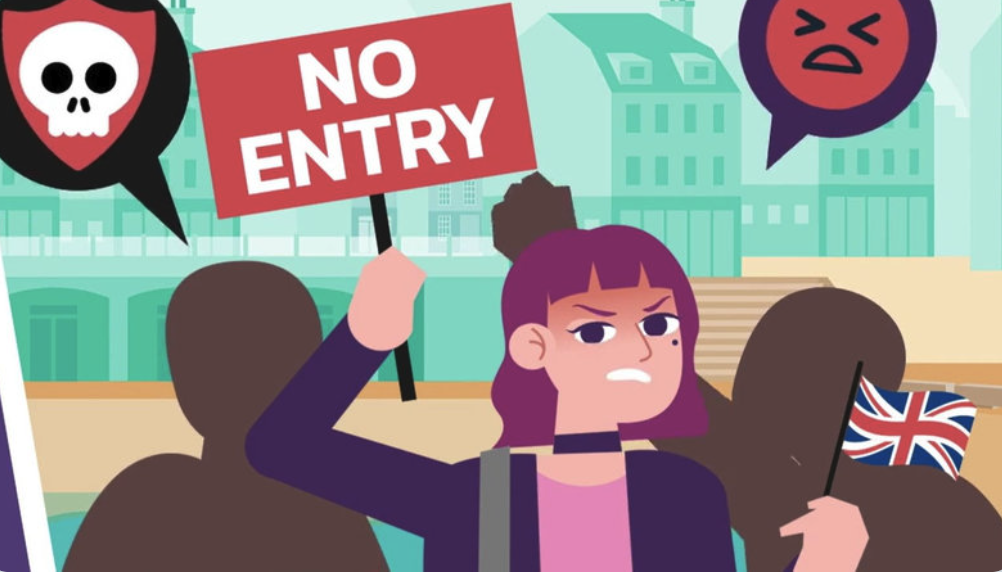
Amelia in the now offline game “Pathways”.
With Pathways, funded by the British Home Office, young people were supposed to be taught how radicalization “works”. What emerged was a digital object lesson in how denunciation is morally elevated and loyalty to humans is systematically devalued.
Amelia, a purple-haired goth girl, acts as the antagonist in the game. She is not a terrorist, not a violent offender, not even particularly radical. Her offenses are unspectacular: She asks questions. She expresses patriotic thoughts. She shows skepticism towards the government. The player’s task is not to convince her, but to isolate her. Whoever befriends her loses. Whoever reports her wins.
The colorless protagonist Charlie must choose between loyalty to humans and loyalty to the system. If he chooses betrayal, he acts correctly according to the game mechanics. The message is clear: Moral behavior does not consist of dialogue, but of exclusion. The player learns what is right by learning who they may drop—and who they must drop.
The game itself was, as expected, not a great success and would have long been forgotten had the combination of social media and generative AI not retroactively made Amelia viral. But here, too, the audience reacted differently than intended. Instead of disgust, affection arose. Amelia was not read as an extremist, but as a dissident with a profile. The goth aesthetic, intended as a visual warning signal, transformed into an attractive e-girl ideal. The narrative flipped—not through arguments, but through sympathy.
The method is historically not new. In the GDR, the state used the classroom as a sensorium. Teachers asked seemingly harmless questions—such as about the look of the news clock or the music between broadcasts. Wrong answers were enough to identify parents as viewers of West German television. Conviction was not the goal, but behavioral steering through social proximity.
Pathways goes a step further. It not only simulates surveillance, it trains it. The player learns that betraying a friend is a moral act. Thus, the game moves dangerously close to a historical phenomenon that once failed spectacularly.
Starting in 1938, short sketches featuring the comedy duo “Tran und Helle” ran before the Nazi newsreels. Helle: young, toeing the party line, lecturing. Tran: older, complaining, skeptical, latently disobedient. The idea was simple: Helle was to explain to Tran—and thus to the audience—why his behavior was wrong.
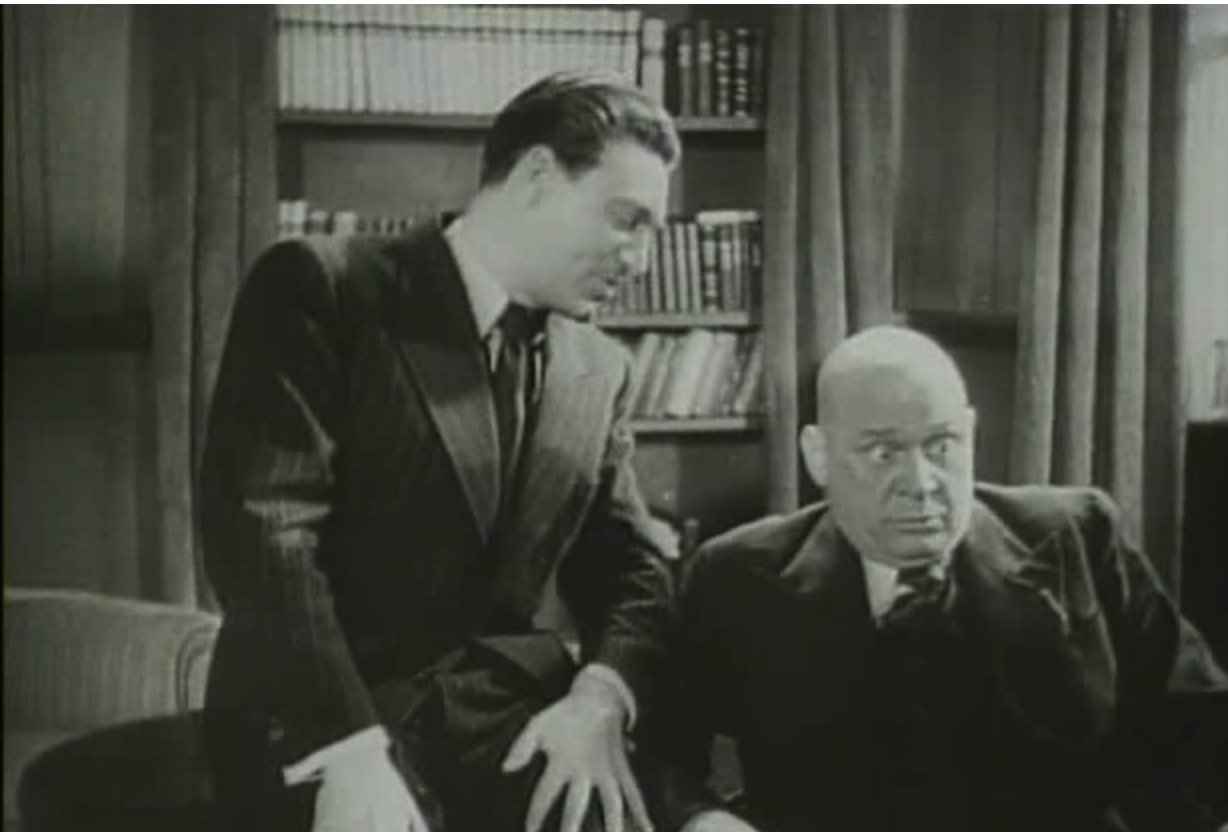
Tran und Helle, Germany, c. 1939, Screenshot United States Holocaust Museum
The audience laughed. But not at Tran, but with him. Tran voiced what many thought, while Helle was perceived as an arrogant know-it-all. The series was canceled in 1940. Propaganda had disregarded one of its basic rules: sympathy cannot be decreed.
Almost ninety years later, the British state has fallen into the same trap.
A self-assured state trusts its citizens to distinguish between information and manipulation. During World War II, Britons listened to “Lord Haw-Haw” out of mockery, not out of fear. Listening to enemy broadcasts was not a capital offense.
Authoritarian systems act differently. They ban because they fear. They seal off because they mistrust their own narrative. That “Lili Marleen” was sung on both sides, while a German whistling “We’ll Meet Again” could be life-threatening, was no coincidence, but an expression of inner insecurity.
When governments today treat social media like enemy broadcasts, it is not a sign of strength. It is a symptom of lost interpretative certainty.
Democratic societies traditionally knew protected spaces of mockery: carnival, court jesters, later formats like Spitting Image. Grotesque, brutal, irreverent—but allowed. Humor functioned as a valve and as a stability factor.
Today, the state no longer reacts to digital mockery communicatively, but administratively. Criticism is legally framed, irony criminalized. This thin-skinnedness is not a moral, but a structural problem. It points to the loss of medial control in an environment that can no longer be centrally steered.
Propaganda was long a privilege of the collective. Printing presses, broadcasters, budgets—campaign capability functioned like a planned economy: predictable, expensive, slow. The result was certain, but usually as lifeless as it was ineffective. Propaganda only works where it does not diametrically contradict reality.
Contrasting this today is the campaign capability of the individual. Generative AI transforms the user into a one-man agency. It is a Darwinian process: fast, brutal, selective. While ministries draft briefings, the guerrilla prompter generates thousands of image variants: Amelia as a mother, Amelia as the voice of reason, Amelia comforting the lonely Prime Minister.
The mass of individuals evolves faster than any state apparatus.
Keir Starmer wanted to be Helle—the lecturing adult in the room. But the moment he made citizens fellow players in surveillance, he himself became Tran: the figure people laugh at because he means it seriously.
The modern state has a problem it cannot solve with laws. It is too slow, too cumbersome, and too humorless for a public that thinks in images and judges in seconds.
Interpretative authority is no longer explained today. It is no longer enforced. It is not even believed anymore. It arises where the state loses control—and exactly there begins its ridiculousness. That is not prevention. That is training.