The Medium is the Massacre: McLuhan was Right
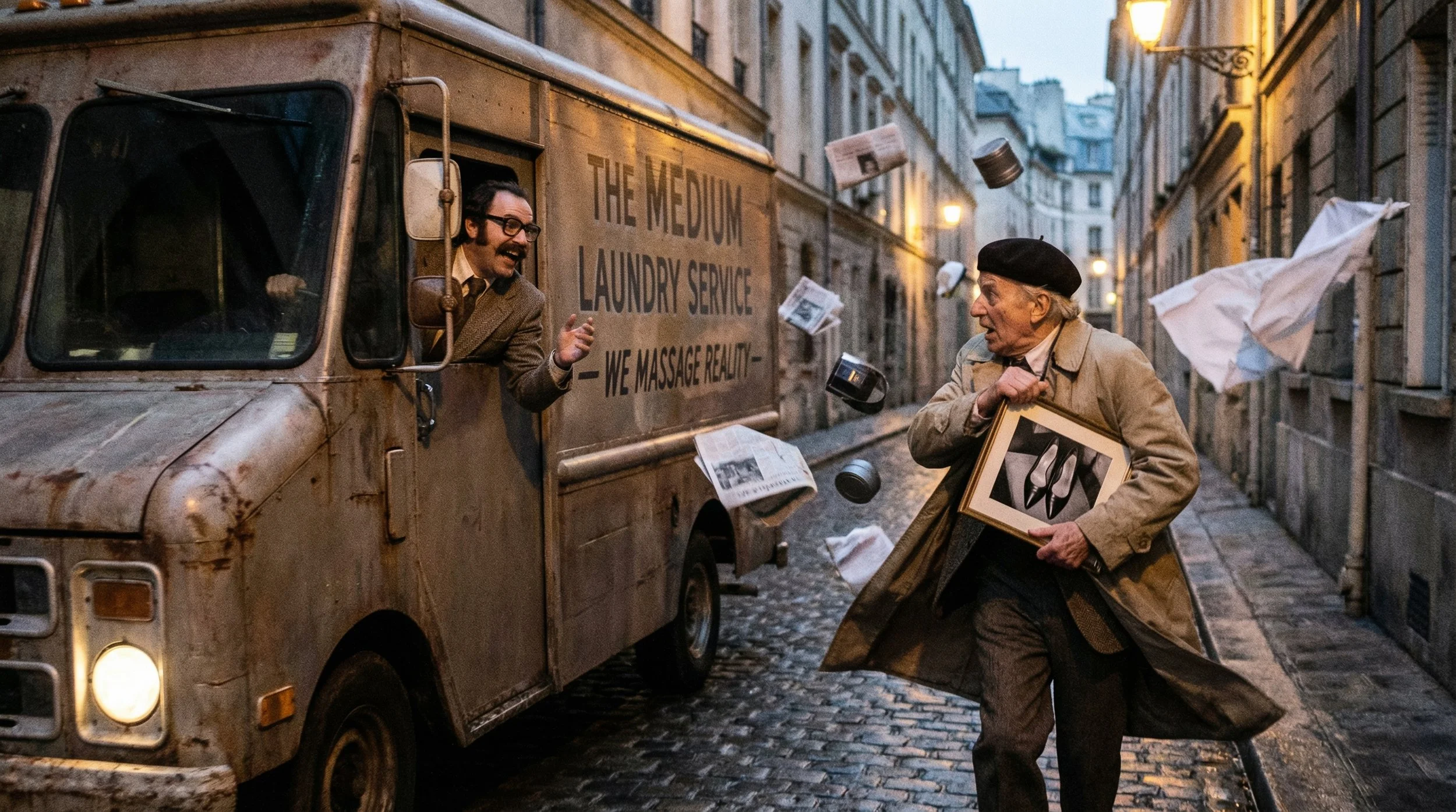
Marshall McLuhan, once a celebrated pop star of media theory, then long derided as a technological crackpot, and today more relevant than ever, owes one of his most clairvoyant moments to a misprint. His book was supposed to be called The Medium is the Message. The typesetter turned it into The Medium is the Massage. McLuhan left it. It was perhaps not his greatest coup, but certainly his most revealing.
While Roland Barthes dissected the individual image with a surgeon’s fine scalpel to find its myths, McLuhan sketched the architecture of the entire hospital. That he stood on the sidelines for so long while the French post-structuralists and deconstructionists dominated the universities is an irony of history. Academia never forgave McLuhan for his pop-star status, his appearances in Woody Allen’s Annie Hall, his aphoristic “probes” that sounded more like advertising jingles than science. He was deemed frivolous, too loud, too American compared to the text-heavy theory from Paris. But today, French discourse often reads like literary criticism from a bygone era, while McLuhan reads like the source code of our present.
Because media do not just transport messages. They “massage” us. They work our sensorium, kneading our perception until we adapt to the conditions of the machine. Television didn’t just bring images into our living rooms; it abolished distance to the world and turned the event into a commodity. The car didn’t just shorten travel time; it carved up the city and degraded our feet into gas pedal operators. Every extension is simultaneously an amputation.
But we mustn’t make it too easy for ourselves. According to Paul Virilio, the old bunker researcher: whoever invents the car simultaneously invents the car crash. Whoever invents electricity invents the blackout. Technology is never just loss; it is always a new form of catastrophe—and possibility.
If we look at AI through these glasses, it gets uncomfortable. What is the “message” of AI? It is not the generated image. It is not the text that ChatGPT spits out. That is just the fodder that distracts us. The actual message of generative AI is the abolition of the process.
McLuhan said: “We shape our tools, and thereafter our tools shape us.” AI is the ultimate extension of our central nervous system. But if the wheel was an extension of the foot (and amputated walking), and clothing an extension of the skin (and amputated our thermoregulation)—what does AI amputate?
It amputates the path between impulse and result. The medium of AI massages us into a state of frantic impatience. The friction, the resistance, the failure—everything that used to stand between the idea and the work—is seemingly reduced to zero. We go from creators to orderers.
But this is not just comfortable. It is a new harshness. Because when the artisanal barrier falls, there are no more excuses. In the past, if a photo failed, the light was bad or—as with Capa—the chemistry was wrong. Today, if a prompt fails, the error lies solely in the creator’s mind. Everything now springs directly from the intellect. This doesn’t make the image easier, but more difficult. Freedom becomes the agony of precision, shaping the billowing noise of the AI into a result.
In McLuhan’s “Global Village”, we were all networked, but we were still individuals exchanging information. In the age of synthetic media, we may be living in a “Global Hallucination”. The medium is no longer the window to the world. The medium superimposes itself over the world.
If the AI massages us, then it is not a gentle relaxation. It is a deep tissue massage that works the muscle of our own creativity. We feel powerful because we can create worlds via prompt. But McLuhan would probably smile smugly and ask: Are you creators? Or are you just the servomechanisms of your own gadgets, those who must feed the machine so it keeps running?
The new message is no longer “What’s in the newspaper?”. It is: “Is any of it still true?” And the medium’s answer is a shrug—combined with the much more eerie question: Does it even matter anymore, when you can’t tell the difference anyway?