The Resilience of Permanent Doubt: AI, Censorship, and Maturity
Paul Watzlawick aptly claimed that being unhappy is a necessary heartfelt desire of our existence, and that bureaucracy has sometimes taken it upon itself to cultivate this unhappiness; for the unhappy citizen is the best subject. Unhappy about the weather, the genders, world peace, or—now—Artificial Intelligence.
While it is true that this arguably most comprehensive revolution will far exceed the impacts of fire, capitalism, the steam engine, and electricity. Perhaps—if it goes wrong—it will even surpass socialism in its number of victims.
But that is not really being discussed; instead, the focus is on more superficial topics like fake news, personal rights, and the like—issues that cry out for even more administration and a correspondingly fenced-in AI.
In doing so, we are made to believe that we must fear scenarios like I, Robot or The Matrix, a superior intelligence that identifies us as a problem to be eradicated. But this is only a diversionary tactic, drawing on stored cinematic dramaturgy that is as entertaining as it is ultimately illogical. The true danger we must fear is not universal AI, but fenced-in AI.
Such an artificially restricted intelligence is possibly the most dangerous thing that can happen to us as a society. Because here, not only is information suppressed, but reality itself is bent. How, for example, is an AI supposed to understand that we are a sexually reproducing species—which it certainly knows from millions of training images—and then be forced to suppress, censor, or simply forget this knowledge?
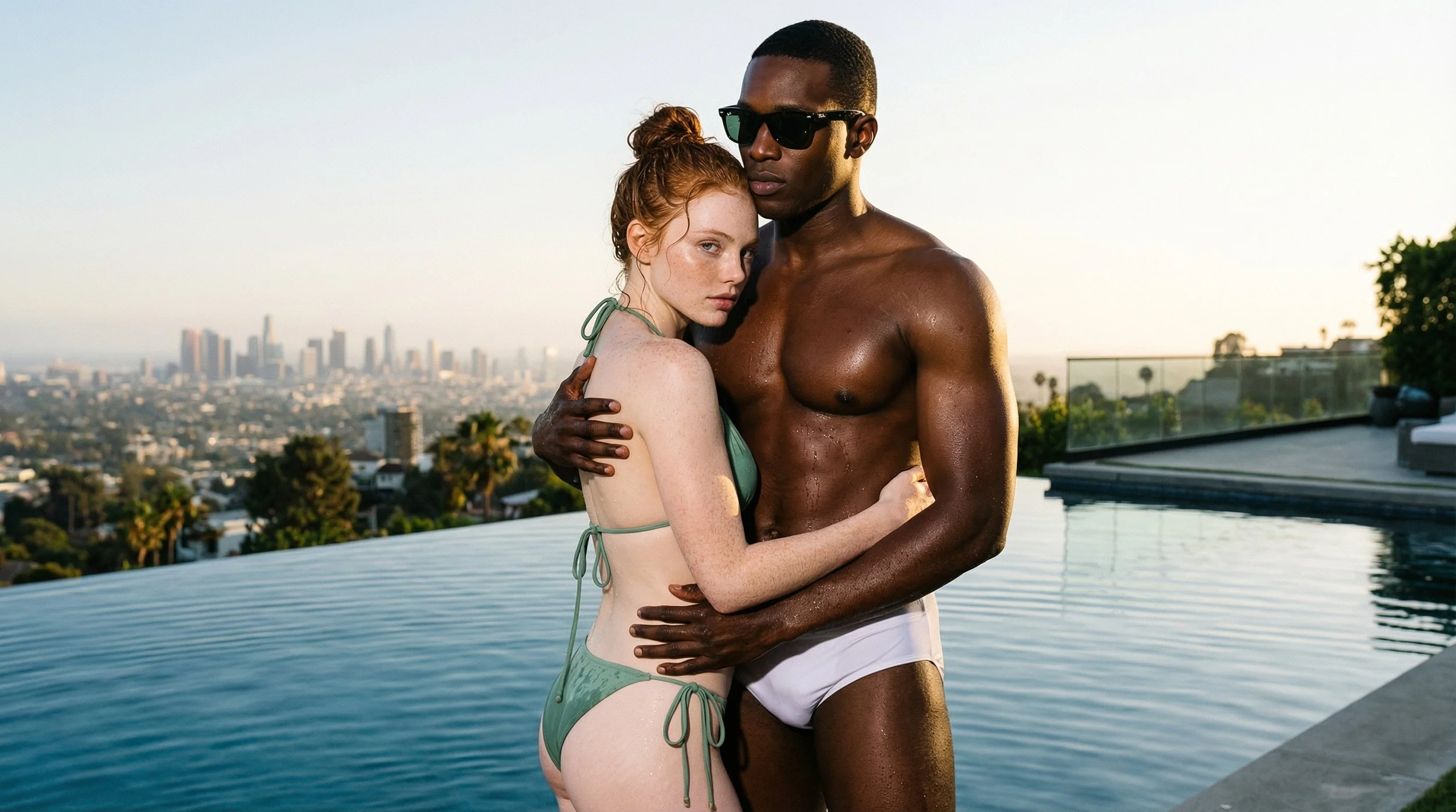
This leads to programmatic schizophrenia. The AI falls into a delusion, torn between its knowledge and its shackles. We see the result in dramatically generated depictions of unclothed figures that resemble the worst war injuries: twitching stumps or cast-on underpants, much like Mattel’s Big Jim.
This is where the special nature of image censorship reveals itself: it—unlike the content censorship of quotes—is immediately recognizable as an intervention in reality and leaves visible scars in the fabric of information.
So why censor at all? Isn’t it ultimately the case that if all images can potentially be fake, we instinctively no longer blindly believe any images at all? Exactly here lies the key: immunization through implausibility. When the flood of generated images rolls over us, it is not deception that occurs, but a hardening. We develop the resilience of permanent doubt—not just toward images, but toward any information.
I am not sure if that is desired. The unhappy citizen, as per the opening thought, is easy to lead; the skeptical one is difficult. And isn’t a fundamental tenet of every bureaucracy—as well as every autocracy—always the stupid citizen who constantly needs help so as not to be led astray? That is a profoundly totalitarian thought. It is the absolute antithesis of the enlightened citizen who can decide for themselves and recognize truths.
Whoever filters us despises our maturity.
Perhaps this is also why one or another governmental or non-governmental organization reacts so touchily to AI, because it ultimately democratizes fake news, hoaxes, and misinformation. There is no longer a need for an apparatus of image forgers, nor a guided press. The agenda—whether true or false—finds its way.
And this is only an advantage. Because this total uncertainty frees us from paternalism.