The Four Laws of Hallucination: Barthes vs. McLuhan
We have already examined how AI as a medium “massages” us in the sense of the early McLuhan and changes our role from creator to customer. But to fully grasp the current shifts caused by generative AI, we must go a step further. The radical upheaval of our media reality demands a more precise diagnosis. For this, I believe it is worth looking at Marshall McLuhan’s late work.
Shortly before his death, he developed an analytical tool called the tetrad, which can be effectively applied to generative AI. McLuhan postulated that every new medium triggers four fundamental effects: it enhances a function, it obsolesces an old practice, it retrieves something from the past, and it reverses into its opposite when pushed to its limits. If you apply this matrix to current technology, a sobering inventory of cultural change emerges.
The first question of the tetrad aims at enhancement. With AI, this is primarily the speed of production and the decoupling of competence and result. The medium acts as an accelerator. It closes the gap between the mere idea and the finished result. Where years of training used to be necessary to achieve artisanal standards, formulating an intention is now sufficient. AI massively enhances output quantitatively. We are experiencing a democratization of creation, which inevitably leads to an inflation of content.
This leads to the second effect: what becomes obsolete? In many areas, AI makes the classic process of learning through repetition redundant. The technical hurdle, the resistance of the material, disappears. As a result, artisanship in the traditional sense loses its relevance. Malcolm Gladwell’s thesis of the “ten thousand hours” to achieve mastery is devalued. However, with the removal of the technical barrier, the productive friction that often increased quality also disappears. When an acceptable result is effortlessly reproducible, the average becomes the new standard.
Third: what does the medium retrieve? Interestingly, interaction with AI reactivates orality. Controlling computers is no longer primarily done via abstract code or mechanical commands, but via natural language. Prompting marks a return to the word as a constituent element. The description of the image creates the image. In a certain sense, we are returning to a pre-literate logic in which what is told shapes reality, except that this now happens through technical mediation.
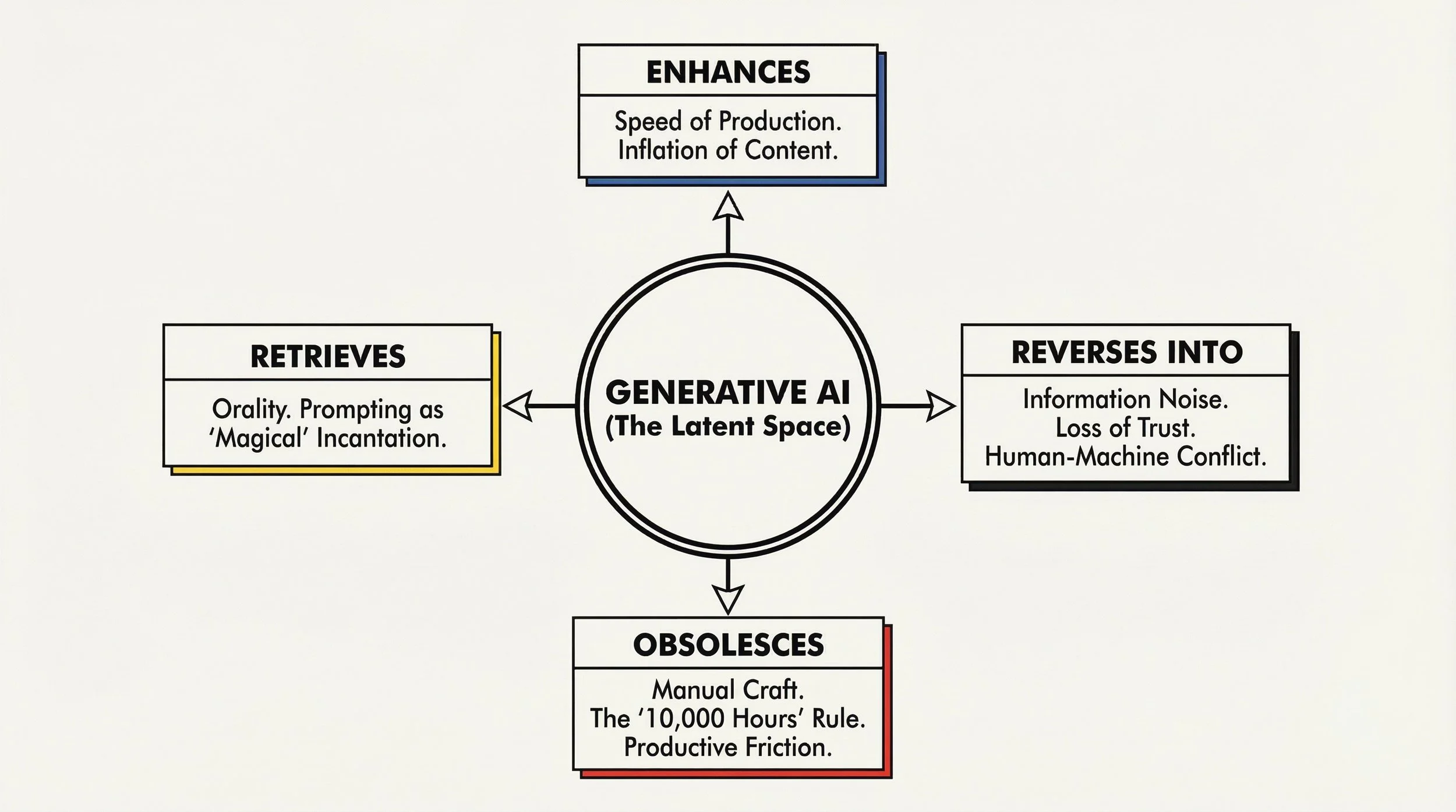
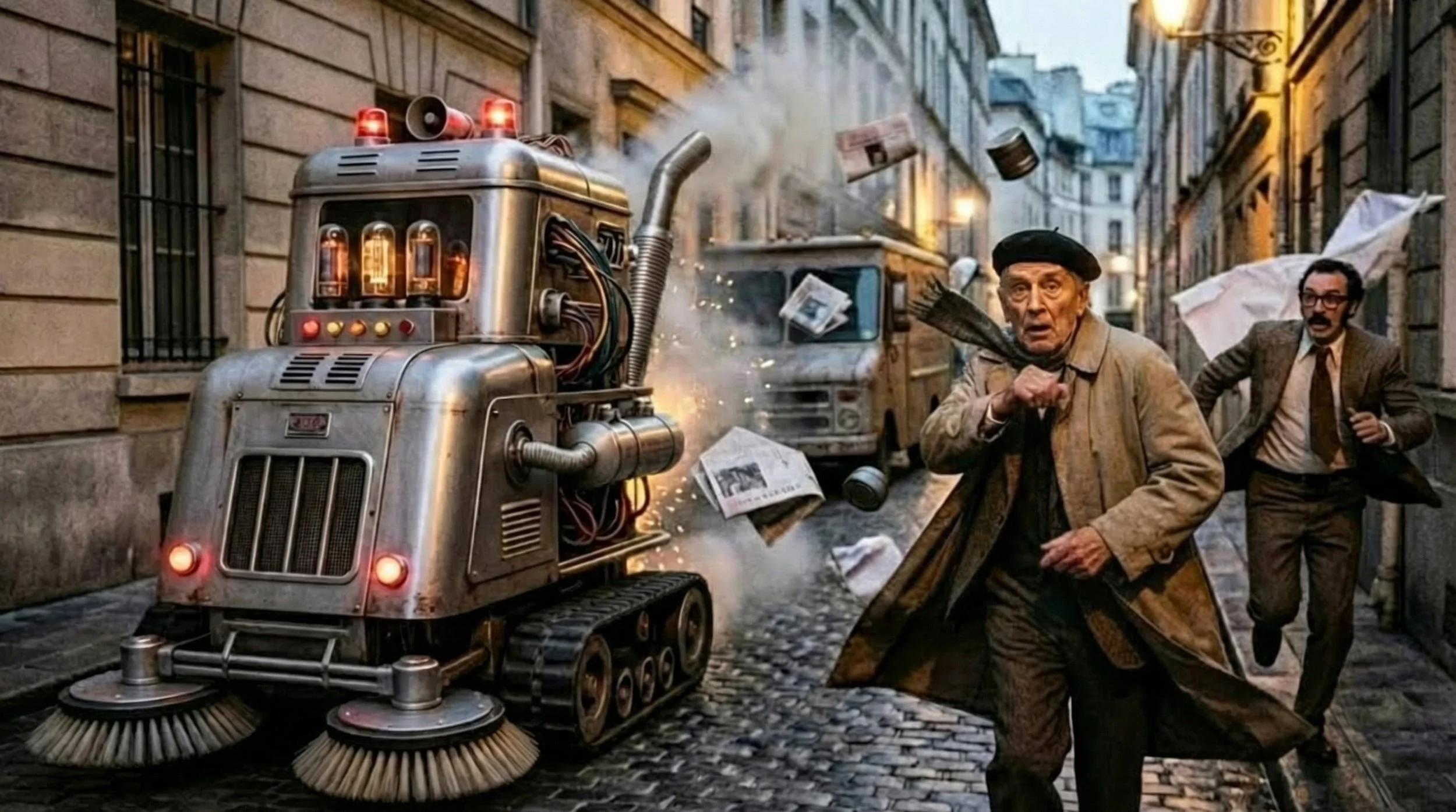
The fourth point of the tetrad describes the medium reversing into its opposite. On the one hand, information flips into disinformation; extreme availability does not generate knowledge, but a noise in which validity can hardly be verified. On the other hand, the relationship between human and machine threatens to tip over. What begins as harmless support—symbolized by the helpful robot vacuum—can turn into defensive aggression if human labor is displaced. The technological promise of efficiency is then no longer perceived as a gain, but as a threat to one’s own professional biography.
This is also where the theoretical break becomes apparent when you contrast McLuhan’s concept of “figure and ground” with Roland Barthes’ definition of photography. For Barthes, the image was the proof of a “that-has-been”; his focus lay on the figure, the irrevocable moment. In generative AI, this approach loses its validity because the referent is missing. There is no “has-been”.
McLuhan offers the more precise diagnosis: we tend to continue staring at the figure (the generated image) and evaluating its realism. In doing so, we overlook the ground. The ground is no longer physical reality casting light onto a sensor, but a latent space. The image is not retrieved, but distilled from statistical noise. While Barthes searches in vain for the truth in the AI image, McLuhan shows that the environment itself—the ground on which the images are created—has dissolved into mathematical abstraction.