The Limits of Imagination: Golems, Terminators, and Unitree
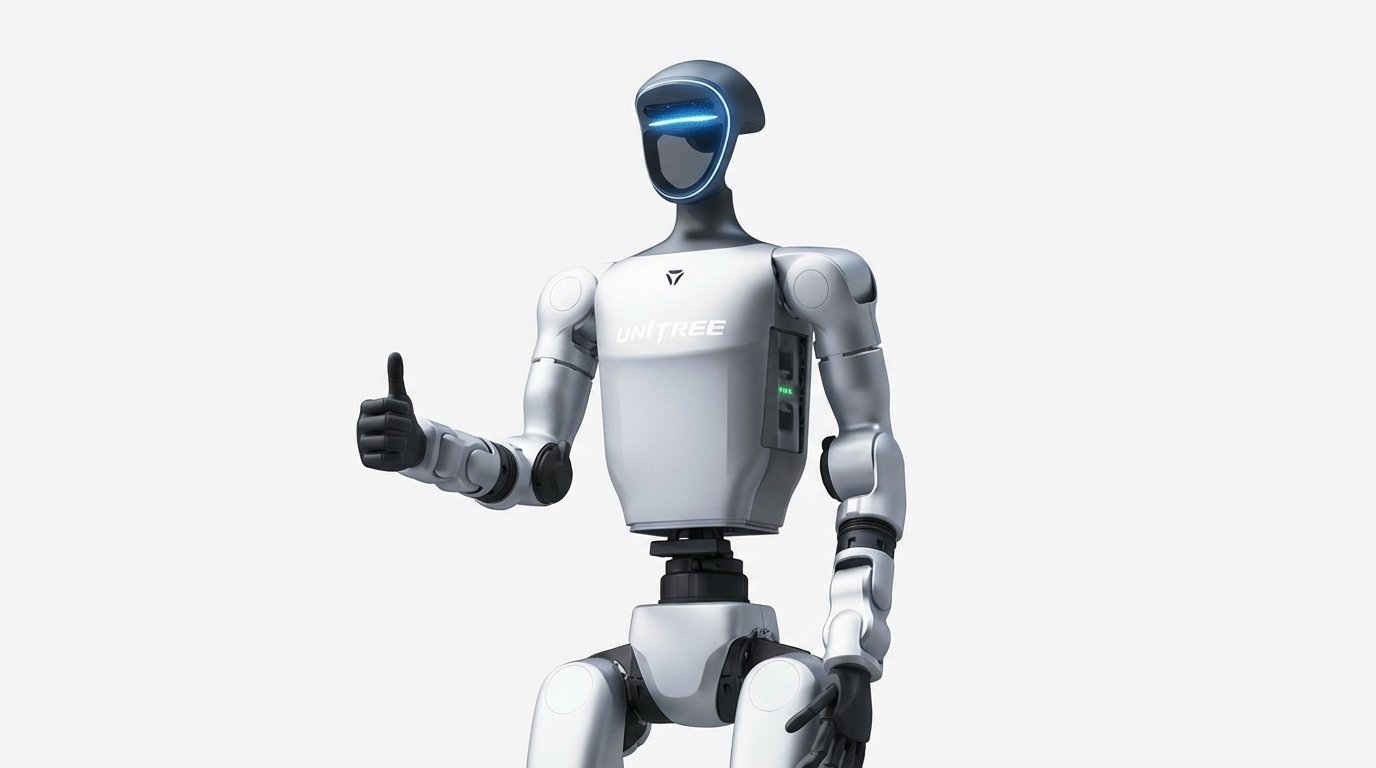
For Chinese New Year, Unitree presented an impressive showcase of its humanoid robot—a performance that, compared to the significantly less harmonious display a year ago, highlights the almost stormy progress in robotics across China and the US. The machines execute choreography—not jerkily, not mechanically, but with a fluidity and precision that clearly challenges, if not surpasses, the human body in acrobatics and elegance. A perfect backflip, a controlled spin, the soft absorption of impact. Comments ranged from “wow” to “definitely fake”; shortly after, the first AI-generated videos appeared, predicting inevitable military use.
The show opened a new horizon: these machines no longer appear merely as industrial arms or military skeletons, but as potential craftsmen—as precise everyday helpers, as bodies in space. No longer just tools, but physical actors.
We have learned to see robots differently—long before they existed in this form. In religious and mystical traditions, the idea of artificial beings already appears in the Golem of Jewish mysticism: a servant formed from clay, animated to perform labor, yet always accompanied by the latent danger of breaking boundaries. An archetype of the artificial thrall.

Film scene, “The Golem: How He Came into the World”, Germany, 1920
In 1920, Karel Čapek coined the word “robot” in his play R.U.R. (Rossum’s Universal Robots). Derived from the Czech robota—corvée, forced labor—it designated mass-produced artificial workers created for alienated activity. The semantic trail is clear: the robot was never a playmate, but a laborer.
For decades, film and media have further compressed this image and shaped our horizon of expectations. Early science fiction showed clunky, metallic constructs whose movements testified to the gravity of mechanics. Disney gave them charm, but the clumsiness remained. Star Wars brought R2-D2 and C-3PO—lovable, quirky, but unmistakably machine-like. The Terminator skeletons strode with cold precision—threatening, unstoppable, yet always betrayed by mechanical stiffness and the whir of servos. Exceptions prove the rule, such as in I, Robot: there, the machines moved with the agility of a weasel, but were surprisingly fragile in return—otherwise, Will Smith would hardly have stood a chance despite hybrid optimization.
These images did not merely entertain. They shaped our sensory memory, formed our visual habits. From then on, being humanoid meant: either comical, uncanny, or existentially threatening. The possibility of a dancing, elegant, almost graceful humanoidity lay outside the archived canon of our media-conditioned imagination.
Our imagination is not a free, autonomous force. It is a product of the images that have settled in our collective visual memory over decades and centuries.
A good example of our “stockpiled” perception is rockets. The sleek, smooth projectiles of early science fiction embodied an elegant vision of departure. Real space travel by the Soviet Union and the US, by contrast, featured clunky, functional colossi full of pipes, struts, and lattices—a form of impressive ugliness. We got used to it. Until reusable, streamlined, backwards-parking rockets caught up with the old visionary images—and made visible just how much we had grown accustomed to the functional deviation.
It is a familiar pattern: we primarily expect what we have already seen. When something then appears that lies outside this conditioned archive—something that no longer seems mechanical, but fluid—we react with surprise. Sometimes even with quiet disturbance. The dancing robots are such a moment.
It is not just technology that is evolving. Our gaze will also relearn. It will discard the old mythical, literary, and cinematic images to recognize what is actually becoming possible. The future emerges not only from technical feasibility, but equally from the willingness of our media-shaped vision to accept new forms.
The machines have already mastered the choreography. Our gaze is still practicing—until we see them laying shingles on a roof. Or with an assault rifle in artificial hands.