Yva and Helmut: The Fractures of the Avant-Garde
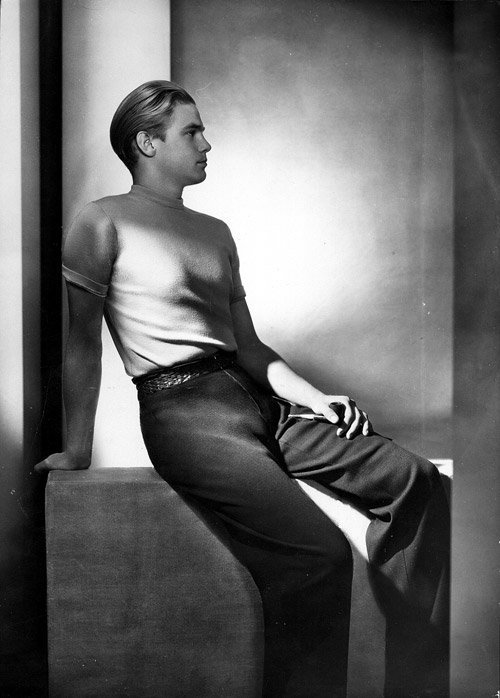
1932 Jantzen - Yva
There is a certain historical symmetry in the calendar of photographic history. January marks almost simultaneously the end and the beginning of two biographies that are inextricably interwoven: On January 23, 2004, Helmut Newton died in Los Angeles. Only three days later, on January 26, would have been the birthday of Yva (born 1900 as Else Neuländer).
Additionally, another date has its 90th anniversary this year: in 1936, the young Helmut Neustädter began his training in Yva’s studio at Schlüterstraße 45. It is an occasion, on the anniversary of his death today, to remember not only the world-famous student, but to turn our gaze to the woman who shaped him—and to the radical break that made Newton’s work what it became.
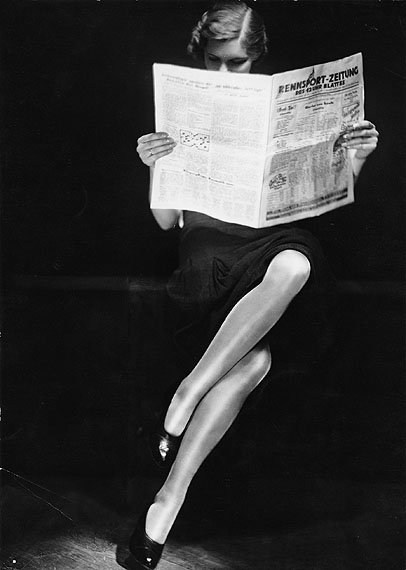
1932 - A Woman Reading a Newspaper, Yva.
When the then 16-year-old entered her studio, Yva was already one of the most renowned female photographers of the Weimar Republic. At just 25, she had founded her first studio and supplied magazines like the Uhu or the Berliner Illustrirte Zeitung.
Yva was a technical pioneer. Her specialty was complex multiple exposures and a surreal, dreamlike visual language that she masterfully employed in advertising photography. She embodied the type of the “New Woman” of that era: employed, economically independent, and style-conscious. Newton learned not only the photographic craft here, but found himself in the center of the Berlin avant-garde.
The young Helmut Neustädter, who joined her in 1936, brought exceedingly little artistic distress. He came from the wealthy Schöneberg upper middle class; his father was a successful button manufacturer. Biographers describe a childhood characterized by the scent of “Chanel No. 5” and the presence of nannies—women who played a large role in his memory and provided his first voyeuristic moments.
He left high school early; his interest lay primarily in swimming and girls. His father’s prophecy that the boy would “end up in the gutter” accompanied the beginning of his apprenticeship. Yva was the Neustädter family’s hope to give the directionless son some structure. In these two years, Newton soaked up the technical foundation that would later distinguish him: the perfect use of artificial light and the staging of fashion as a social statement.
While Newton learned the craft, Yva was already fighting for her professional existence. To protect her studio from the grasp of the National Socialists, she officially handed over management to her friend, the art historian Dr. Charlotte Weidler, in 1936.
It was an attempt to survive through adaptation in Berlin society. Weidler was no stranger, but an established expert and travel companion of Yva. But the choice of this “straw woman” shows the entire tragedy of the time today: Weidler, who nominally “Aryanized” Yva’s studio, would later play an extremely dubious role in connection with looted art (for instance in the Paul Westheim case). Yva relied on a network that was already eroding morally. Yva did not flee. She remained in Berlin, perhaps hoping that her fame would protect her. But the reality of the regime could not be tricked by bourgeois connections.
For Helmut Neustädter, the end in Berlin came with the November pogroms of 1938. He fled, first to Singapore, then to Australia. Here, the privileged manufacturer’s son experienced a social downfall that must have been formative for his later work. He was interned as an “Enemy Alien” and served in the Australian army starting in 1942. Instead of staging fashion, he worked in road construction, mixed cement, and drove trucks.
This break might explain why Newton’s later style is technically based on Yva’s school, but atmospherically speaks a completely different language. The dreamy softness of Yva’s pictures gave way to a sculptural hardness and coolness in Newton. The years in exile, the physical hardship, and the distance from the lost homeland sharpened and disillusioned his gaze.
While Newton took Australian citizenship in 1946 and started anew as a photographer, Yva could not save herself. Her attempt at mimicry failed. After an occupational ban and forced labor as an X-ray assistant in the Jewish Hospital, she was deported in 1942 and murdered by the National Socialists, presumably in the Majdanek extermination camp.
When we look at Newton’s work, we thus see a synthesis: the technical perfection and elegance come from Schlüterstraße. But the unapproachable strength of his female figures, who often look as if they are wearing armor, is perhaps the answer of a man who saw how fragile a civilized world can be.