Orwell, Amelia, and the Creeping Loss of Open Societies
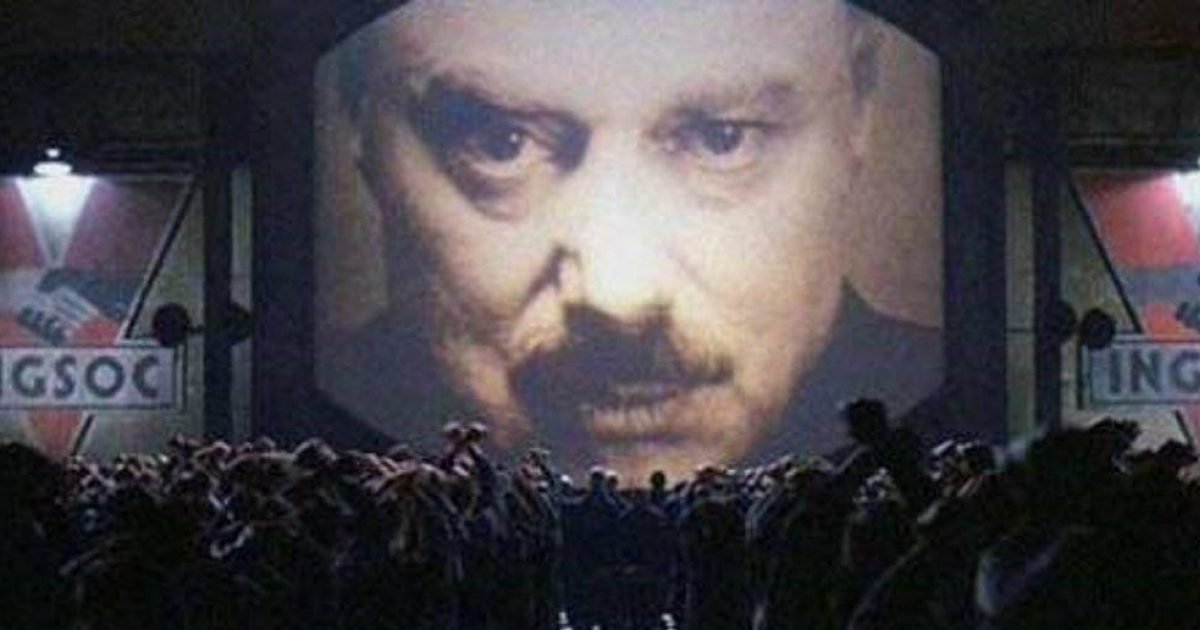
(1984) - Film scene, Screenshot, Medial Framing
Amelia—the hijacked artificial figure—is not a scandal, but a symptom. She holds a mirror up to a state that has forgotten what its own stability was once built on: free speech, open debate—and the willingness not to manage dissent, but to endure it.
George Orwell did exactly that after World War II. 1984 and Animal Farm were not retrospective reckonings with National Socialism—that was dealt with for Orwell in 1945—but warnings about the future of his own country. Both books emerged from the concern that Great Britain could slip into a morally legitimized but structurally authoritarian socialism after the war. Free speech (1984) and the free market (Animal Farm) do not appear as ideology in Orwell, but as conditions for the survival of open societies. Friedrich August von Hayek’s The Road to Serfdom articulated the same fear at the same time, merely more economically precise.
That Orwell’s dystopias are often read today with National Socialist aesthetics is less due to historical insight than medial framing. Uniforms, monumental buildings, symbolism—the visual repertoire of totalitarianism is fed from National Socialism, although Orwell’s target was a different system: the all-encompassing, morally justified administrative state.

Saunders Roe Princess 1953 (RuthAS, CC BY 3.0)
Great Britain had real reasons for this fear after 1945. The Empire was practically lost, privileged access to world markets had ended, the gold reserves had migrated to the USA through Lend-Lease. The country saved itself in a dirigiste commission capitalism, which in the medium term had catastrophic consequences—especially for the manufacturing sector. The British automobile industry is just the most famous example. Resources were not guided by market feedback, but by committee decisions. Technically brilliant, economically senseless projects like the Saunders-Roe SR.45 Princess symbolize this mismanagement—while Boeing in the US said ‘hold my beer’ at the same time and built the 707.
Meanwhile, the destroyed, divided Germany experienced—paradoxically—a rise. Despite territorial losses, it possessed three crucial factors: education, energy (coal), and privileged access to the largest European sales market. After start-up financing, what was later called the economic miracle emerged in the free part of Germany. Freedom, law, and unity met with structurally favorable conditions—despite all intellectual and physical destruction.
And yet Great Britain long remained a model—at least culturally. In matters of free speech, mockery, institutionally permitted irreverence. The BBC, but also Monty Python, Spitting Image: political satire as a valve and as a stability factor. Formats that were never conceivable in Germany because they did not caricature authority, but demystified it.
That Great Britain of all countries reacts today with administrative nervousness to digital mockery marks more than just a communication error. It points to the creeping loss of that self-assurance that open societies must bear if they do not want to evade into control.
Great powers rarely disappear spectacularly. They erode—first economically, then culturally, finally mentally. We have experienced the fall of old empires and observed the rise of China. It would be presumptuous to believe that one’s own civilization is immune to this creeping decay. Without individual freedom, law, and unity, they become mere administrative mass. It is also safe to assume that wherever education, markets, or access to energy are weakened, freedom, law, and unity subsequently come under pressure as well.
Amelia is therefore not a British curiosity. She is a symptom of large parts of Europe. And Germany is right in the middle of it, not just geographically.