Captain O’Keefe and the Eight-Nation Alliance: Beijing 1900
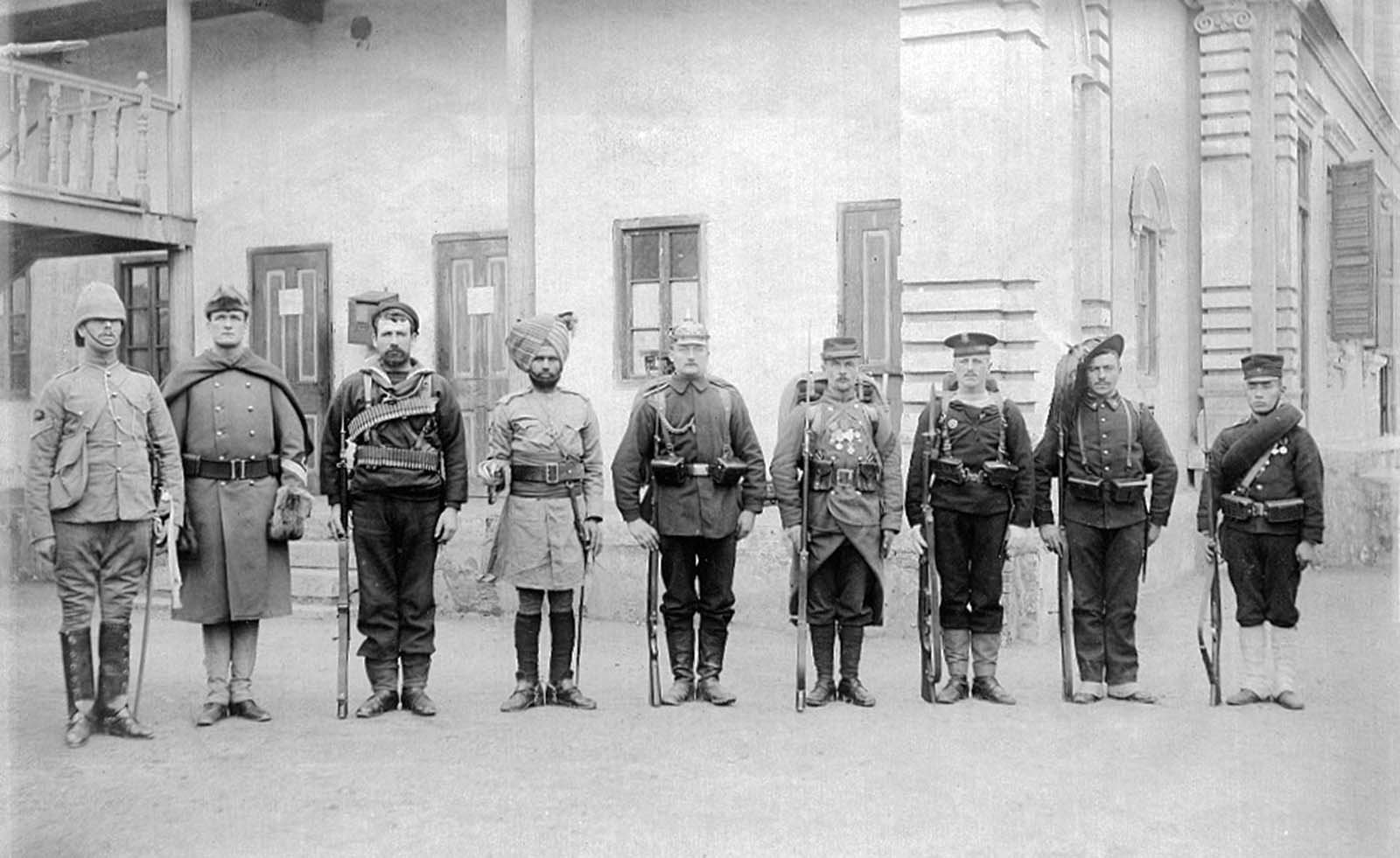
Troops of the Eight-Nation Alliance, photographed by Captain F. O’Keefe, Beijing 1900. - U.S. Library of Congress
The strapping gentleman in the middle and the third from the right would confront the rest of the gentlemen lined up here not as allies, but as enemies, just fourteen years later in the first great war of annihilation of the 20th century—joined by the Russian representative missing here. Less than five decades later, hardly anything remained of this order. By the end of the century, the man with the gloves remained the sole representative of a world power.
The image of the Eight-Nation Alliance in Orwell, Amelia and the Transience of Great Powers inspired me to write another text—more precisely: to research its reception. On a whole series of websites that display this photograph, I came across attributions such as “racist” or “racist propaganda”. The reasoning: the Japanese soldier was placed on the far right in order to emphasize his smaller stature compared to the English and Americans standing on the far left.
This reading is nonsensical in several respects. First, historically: the image composition does not follow an ideological program, but a typical order of documenting military photography at the time. The so-called “organ pipe” arrangement—tall to short—was common practice around 1900 and by no means an expression of subtle hierarchization along ethnic lines.
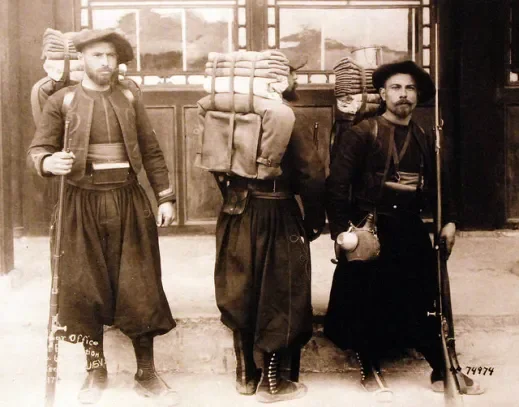
French Zouaves (1) - Captain F. O’Keefe, Beijing 1900. - U.S. Library of Congress
Added to this is a visual aesthetic objection. On the same day and at the same location, at least one other photograph was taken showing the same soldiers in a firing line—the front row kneeling, the back row standing, all with rifles trained. Behind the formation are two cavalrymen, an Englishman and an Indian, slightly blurred by motion. In this photo, France is overrepresented: marine infantry, colonial troops, and Zouaves (1) dominate the image, presumably simply because more French soldiers were available. The numerous spectators with characteristic headgear leave little doubt about this.
This photograph was distributed as a postcard in Germany—despite clear retouching to conceal the motion blur of the riders. Apparently completely unbothered by the strong presence of the then “hereditary enemy” from across the Rhine. Here, too, the argument of the “little Japanese man as a useful helper to white colonial powers” further loses weight: the Japanese soldier is depicted kneeling—his height is therefore pictorially irrelevant.
The original photograph shows, from left to right: an English and an American officer; an Australian infantryman; an Indian cavalryman; a German infantryman with a marksman’s lanyard in a still Prussian-blue uniform; an Austro-Hungarian marine; an Italian Bersagliere—and finally, a soldier of the Japanese infantry.
The photographer of the shot, Captain Cornelius Francis O’Keefe (2) of the 36th U.S. Volunteer Infantry, accompanied the American expedition under Major General Adna Chaffee to China. O’Keefe was not an accidental eyewitness but a professionally trained military photographer: even before the Boxer Rebellion, he had worked for the Corps of Engineers in Manila, producing photographic documentation.
During the campaign, he moved between the front and rear areas of the expedition with his camera and escort. In doing so, he used the close contact with international troops, who could well be future adversaries, to systematically record uniforms, equipment, and postures. His photographs show less the gesture of propaganda than the impulse of recording.
Alongside situational shots—patrols, positions, movements—an almost catalog-like visual language emerges. Different uniforms, different military cultures, made visually comparable. In retrospect, these series almost seem like an involuntary typology of military presence—sober, serial, ordering. The comparison with the later work of Bernd and Hilla Becher is less formal than methodical.
The frequently invoked reading of a deliberately “racist” pictorial composition fails to recognize precisely this documentary gesture. Order here serves overview, not ideology. Height, posture, and uniform are formal parameters—not political codes.
The broader historical context makes many of today’s projections completely baseless. Since the Opium Wars and at least since the Boxer Rebellion, China had been in a phase of massive political and military weakness. Japan, on the other hand, had already established itself as an independent imperial power in the First Sino-Japanese War (1894–1895)—modernized, industrialized, and highly militarily efficient.
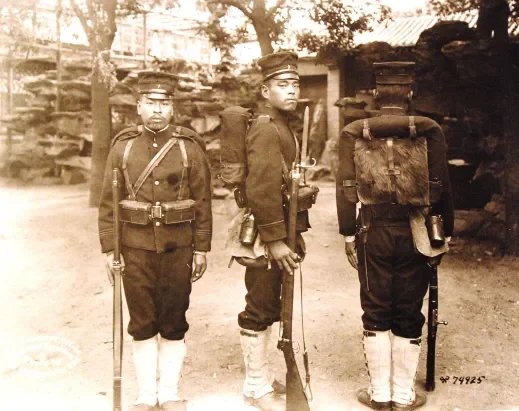
Japanese Infantry - Captain F. O’Keefe, Beijing 1900. - U.S. Library of Congress
Japan did not appear here as a “useful idiot” of an exclusively white colonial ideology, but as an independent actor with clear power-political interests. Anyone who primarily wants to recognize a racist narrative in the depiction of the Japanese soldier is projecting backwards an ideology that does not withstand historical reality.
Only a few years later, Japan would defeat Russia in the Russo-Japanese War (1904–1905) in a dramatically short time—the first time that an Asian power defeated a European great power in a modern war. No fringe event, but a warning sign of the 20th century.
A look at actual troop strengths also contextualizes many interpretations. After Japan, Russia provided the second-largest contingent of relief troops—yet is not represented in the famous photograph. Not for propagandistic reasons, but out of simple photographic reality: photography is always also a product of coincidences, of availability, of presence.
Great Britain, in turn, was strategically overextended. The Boer War tied up considerable forces, which is why the Empire fell back on Australian and Indian troops—a circumstance that becomes visible in the picture without being ideologically intended.
That this very arrangement is read today as a racist cipher says less about the year 1900 than about our present. The photograph does not show an ideology, but a historical moment shortly before the tectonic shift in global power relations.
Racism? Not at all. Contemporary history? Absolutely.
Because it was Japanese troops—with only minimal British participation—who ended German colonial history in China in 1914 and took the leased territory of Qingdao. A colony to which Germany today has left only a few architectural fragments and beer—and which, in direct comparison, now looks significantly more modern than the former colonial power.
Anyone who still primarily wants to recognize a racist narrative in this picture is engaging less in historical analysis than in present-oriented self-reassurance. The photograph is thus not read, but recoded: as a projection surface for a theory that prefers to discover hierarchies rather than explain them—and prefers to sort power relations morally rather than understand them historically.
That says a lot about our time. It says nothing about the year 1900.