In the Dark Valley: Shrek, Mori, and AI Nostalgia
The Uncanny Valley describes the psychological phenomenon in which a human-like figure irritates us precisely because it looks almost real. Almost—but not quite. A robot, an animation, a digital face: the closer they get to human, the stronger the feeling of the uncanny can become as soon as a tiny remnant of artificiality remains visible.
This first became apparent to a broader public with the release of the first Shrek (2001). Technically, the studio was already capable of rendering a much more realistic Fiona—in her human form—but found in tests that the less realistic-looking version met with higher acceptance than the more realistic representation for the time. The almost perfect simulation created irritation instead of identification. The term itself, however, goes further back: in the late 1970s, the Japanese roboticist Masahiro Mori first described this phenomenon as the “uncanny valley”—the point at which increasing realism no longer leads to greater closeness, but to repulsion.
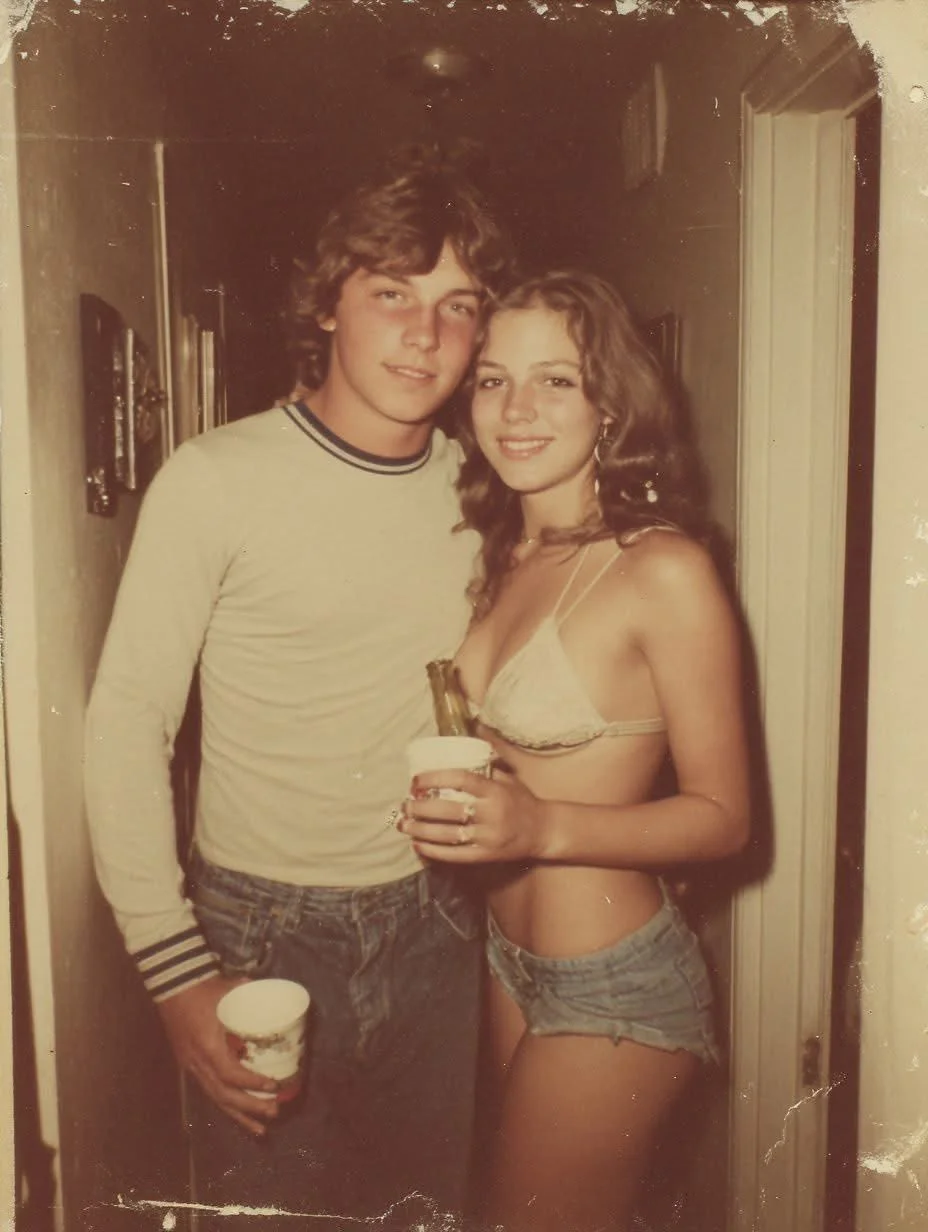
A photograph circulating on social media—among many others—lies exactly in this valley, in my view. It is probably—with high probability—AI-generated; however, this origin cannot be clearly proven. Something is off. And at the same time, everything is so cohesive that precisely this perfection in the imperfect becomes suspicious.
The Perfect Relic
The picture shows a young couple, late seventies or early eighties. Presumably at a party, in a narrow hallway of a single-family home somewhere in the US. It is the perfect social media relic for the phrase: everything was better in the old days—the parties, the relationships, the unbearable lightness of being. Grain, color shift, scratches, slightly yellowed edges—all the traces of the analog past are present. Too present.
A reverse image search leads into the void of the present: the photo has only been appearing on the net for a few weeks. Supposedly older finds on social networks prove to be deceptive; search engines do not date the picture, but the respective original post. If the photo were real, it would have had to exist long before the age of generative image models. But apparently, this is exactly not the case.
The Kujau Paradox
The AI itself doesn’t help here either. The question of whether this is AI is reliably answered with no—regardless of whether it’s Grok, Gemini, Claude, or ChatGPT. Only Gemini voices doubts at the same time; for everyone else, the case is clear. This creates a peculiar situation: the systems that can generate images no longer unequivocally recognize their own potential products.
At the same time, numerous viewers ask exactly these AIs whether the picture is real—and let their own doubts be placated by the potential creator of the photograph. It recalls Konrad Kujau, the Stern magazine, and the Hitler diaries: we ask the forger to confirm authenticity.
Clues Without Proof
As real as the image looks, as fake it might be. And yet: no detail provides definitive proof. The fingers perhaps a touch too long—but not impossible. The young woman’s skimpy bikini entirely conceivable for that time, just like the very short hot pants. The beer bottle held a bit awkwardly, the torso lines overdramatized, almost like a woman without a lower body—and yet: everything could be explained. Every single detail moves within the statistical margins of the real. Clues, but no proof of a synthetic origin.
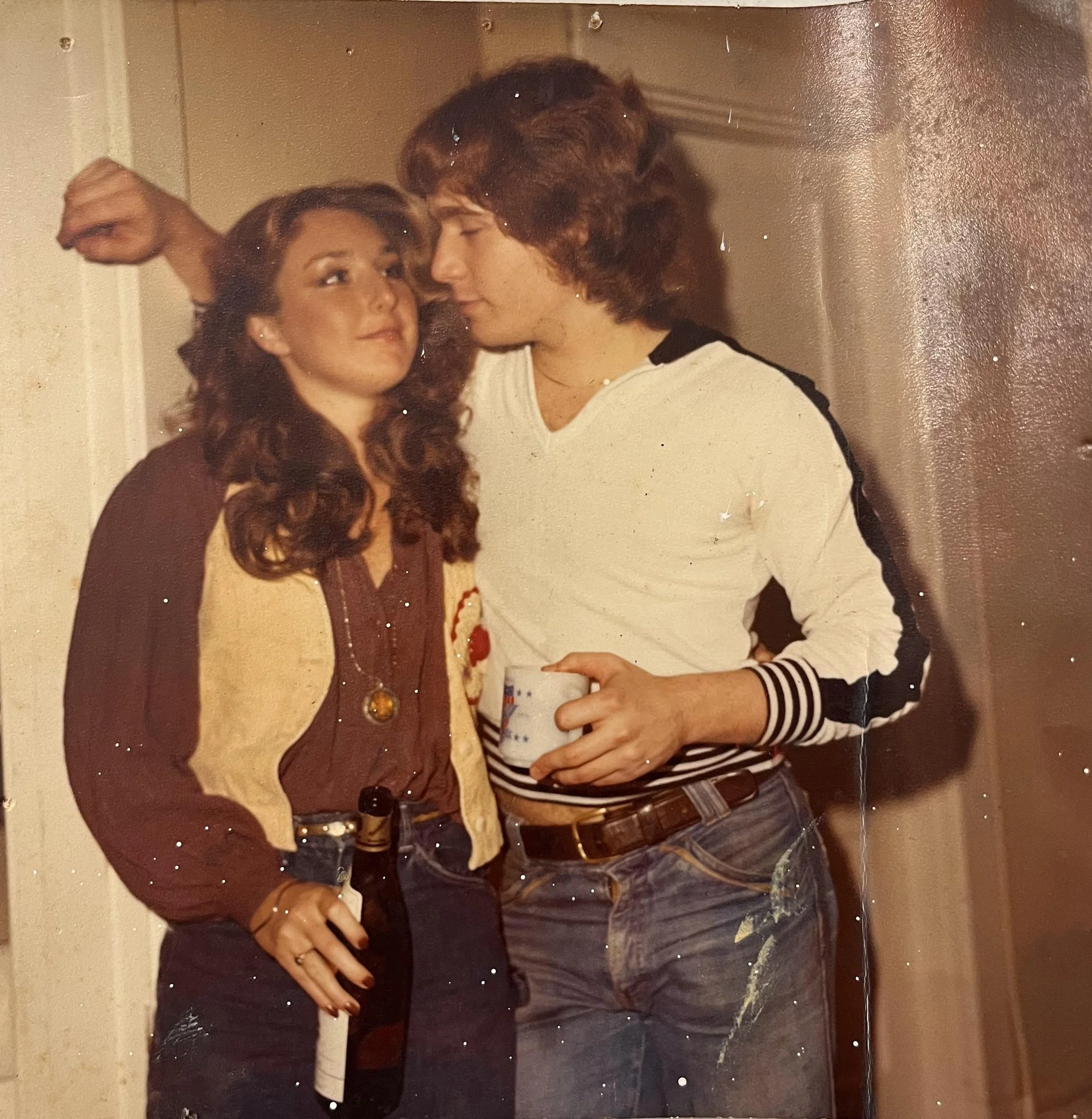
Internet find—the likely origin of the AI photograph: the inertia of the AI ‘took along’ elements (cuffs, bottle, but also location and perforations) or transferred them into the later result. Proof? None. Just a feeling…
The reverse image search, however, reveals another, probably authentic photograph, as it is certainly older. Also a young couple, also with a cup and a beer bottle—just not fitting so perfectly into today’s backwards projection. But exactly as it probably was back then: less perfect, less sexualized, more greasy hair and pubescent insecurity. It is safe to assume that this photograph was the origin of the AI generation—with the prompt to make it more consumable, smoother, more connectable to our memories. Not to the reality of the time, but to the image we want to have of it today.