Trucks in Bergamo: How Photos Shape Fear and Reality
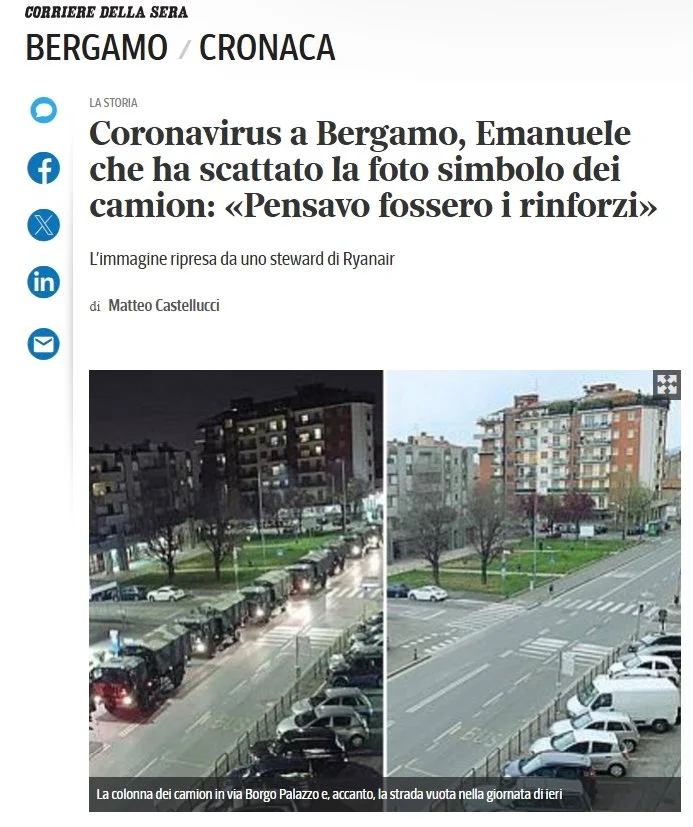
The scene captured by Di Terlizzi on the left, the same location during the day on the right. C Corriere Della Sera, Bergamo March 26, 2020.
Until March 18, 2020, Corona was one crisis among many. Reports from China or from the carnival in the Lower Rhine—both seemed equally distant and foreign. A medially accompanied threat like so many before: mad cow disease, bird flu, SARS, or Ebola. But then the photographs of an endless column of military trucks burned themselves into the private attention economy. In a cloak-and-dagger operation, they roll through Bergamo. Their cargo—first rumors, then reports: corpses. Many corpses. Countless victims of an apparently unleashed pandemic. The convoy of trucks had neither beginning nor end, could not be quantified.
How many bodies can a truck with a five-ton payload transport? Thirty? Forty? Fifty? Apparently there was no more room for piety, no space for mourning. Death became a task of military logistics. How dramatic must the situation on the ground be then? If hundreds, if not thousands, of the 100,000 people in Bergamo are apparently dying in a very short time—what does that mean for me?
The image that turned an abstract threat into a very real one was apparently taken by chance—shot from the balcony of the then 28-year-old Emanuele Di Terlizzi. A neutral, incorruptible eyewitness, a citizen journalist, whose camera seemed to shed light on this operation.
In the already gathering fog of the frequently contradictory Corona reporting—between poorly researched facts, media hysteria, official announcements, individual horror, and real fear—two other images circulated almost simultaneously that were also attributed to the pandemic. First, a photograph of the morgue following the sea disaster off Lampedusa, taken years earlier after a shipwreck in the Mediterranean on October 3, 2013. Second, an incorrectly—or at least incompletely—captioned drone flight over Hart Island, New York—a site for pauper burials, whose usual anonymous mass burials from a distanced bird’s eye view became the symbol for pandemic mass graves.
Both images received a tremendous emotional charge through the shifted context—regardless of their actual origin, regardless of whether simple fake news or half-true deception.
Stored Icons of Fear
The trucks of Bergamo charged their meaning from the stored images of our collective media memory. These stem from our history as well as from fiction, from entertainment. A fitting—and, given the film’s success at the time, collectively retrievable—image comes from the drama Outbreak (1995). There, too, the military enters a sealed-off city—Cedar Creek, somewhere on the US West Coast, where, after the zoonosis and subsequent mutation of an Ebola pathogen, the situation rapidly spirals out of control.
What follows the arrival of the military in the film is the dramatic escalation at the end of the second act: A young mother is separated from her family during a strict quarantine. In rapid succession, she goes through all phases of the disaster—evacuation, internment, agonizing death, and finally anonymous incineration. Parallel to this, the film shows as exposition the projection of potential casualty numbers in the USA—cut against scenes in which body bags are closed, bodies are loaded onto trucks, and ultimately hundreds of dead are burned in a remote barn.
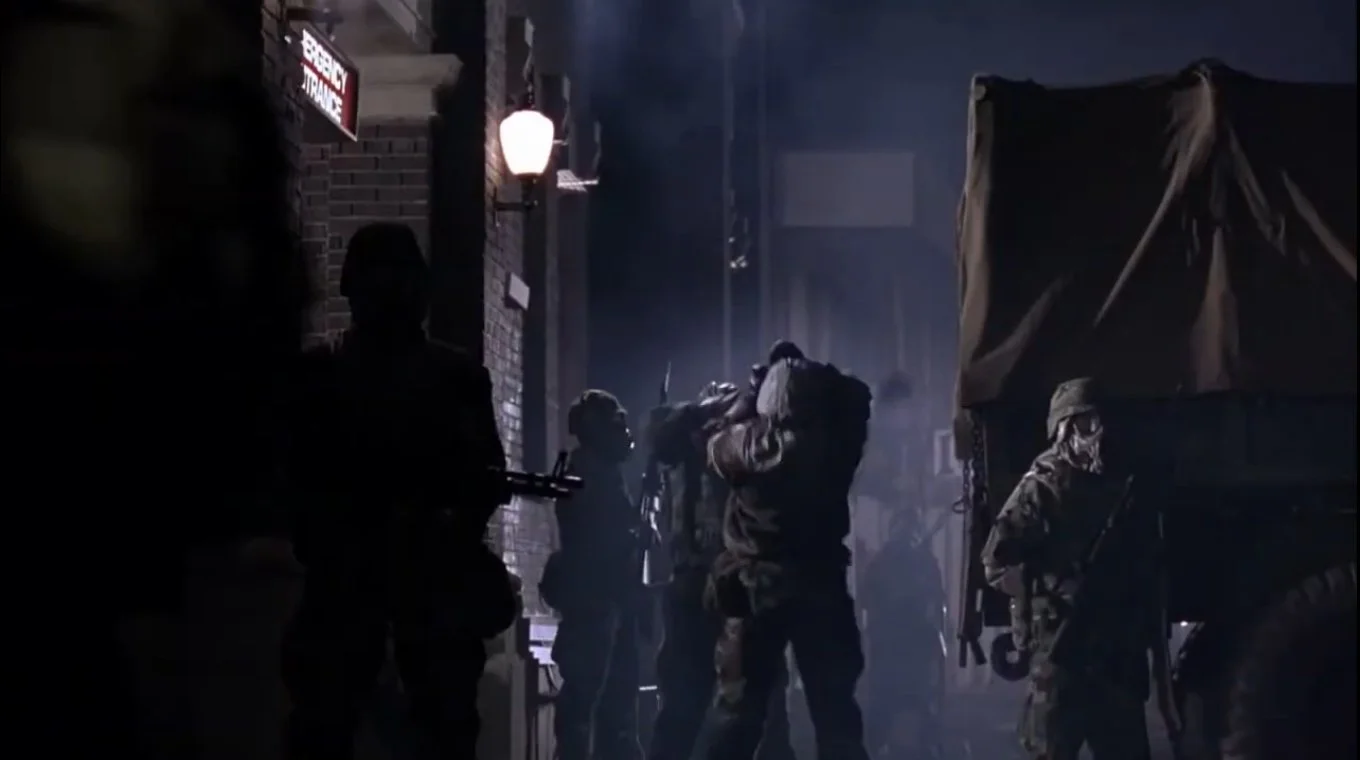
Film scene, loading military trucks with victims - Outbreak, 1995. Director: Wolfgang Petersen, Distributor: Warner Bros. Pictures
These images take hold, are highly effective—not only because they serve the primal fear of the collapse of order, the dissolution of society, but also because this rupture of civilization breaks over those affected as quickly as it is unstoppable. At the end of the cinematic escalation, there is no more hope, everything seems lost. Hollywood’s fiction, however, switches to the third act of the film, which ends in the heroes’ equally courageous and successful confrontation with virus and fate.
In reality, however, the trucks of Bergamo became a warning sign. We are not at the beginning of a disaster, we are already right in the middle of it. What was not communicated, or communicated only inaccurately, our brain automatically supplemented. How many bodies might be in one truck? The column was endless. It was only said: “Many dead.” But how many exactly remained open—our imagination, fed by the images of the past, however, fills the vehicles to their capacity limit; and there is no one to contradict it.
When Fiction and Reality Overlap
The military trucks in Bergamo were indisputably real—and probably not a conscious staging either. And yet they seemed to a Western public like a scene from a disaster film. The visual grammar was long known. It comes not only from Outbreak, but from countless war and apocalyptic films: flight, lockdown, transportation, systematized death.
At this moment, a visual language that had previously been reserved for fiction or the past—war archives, disaster documentaries—transferred into the immediate present. This made the images from Bergamo powerful—not because they showed something terrible, but because we read something even more terrible out of them.
Iconography of Disaster
Images do not work in isolation. They access existing image worlds. A successful, effective photograph always explains itself in the dualism of itself: what it shows, and what we see, therefore also what we want to see—or should see.
The endless train of trucks joins the long iconography of industrialized death: trains of deportation. Transports of corpses from war zones. Or indeed—as a pop cultural reference—the quarantine logistics in Outbreak.
The potency of such images feeds on three levels: what is actually shown—military trucks, dark streets, cones of headlights, endless rows. From this we read the invisible, the unspoken meaning: What is in these trucks? What does it smell like there? Why are they driving at night? The image does not show everything, but it suggests everything.
This is reinforced—or, forgive the pun, boosted—by the memorable: the stored images in the viewer’s head—fed from films, news, history books. The trucks of Bergamo work because we remember what similar images meant in other contexts.
The Image as a Shock Amplifier
The shock of Bergamo was not only a shock about the number of dead, but also about the fact that one’s own protective mechanisms—material as well as psychological—apparently no longer functioned. The picture said: This is not somewhere else. Not in Asia. Not in a war zone. Not science fiction. It is here. It is now.
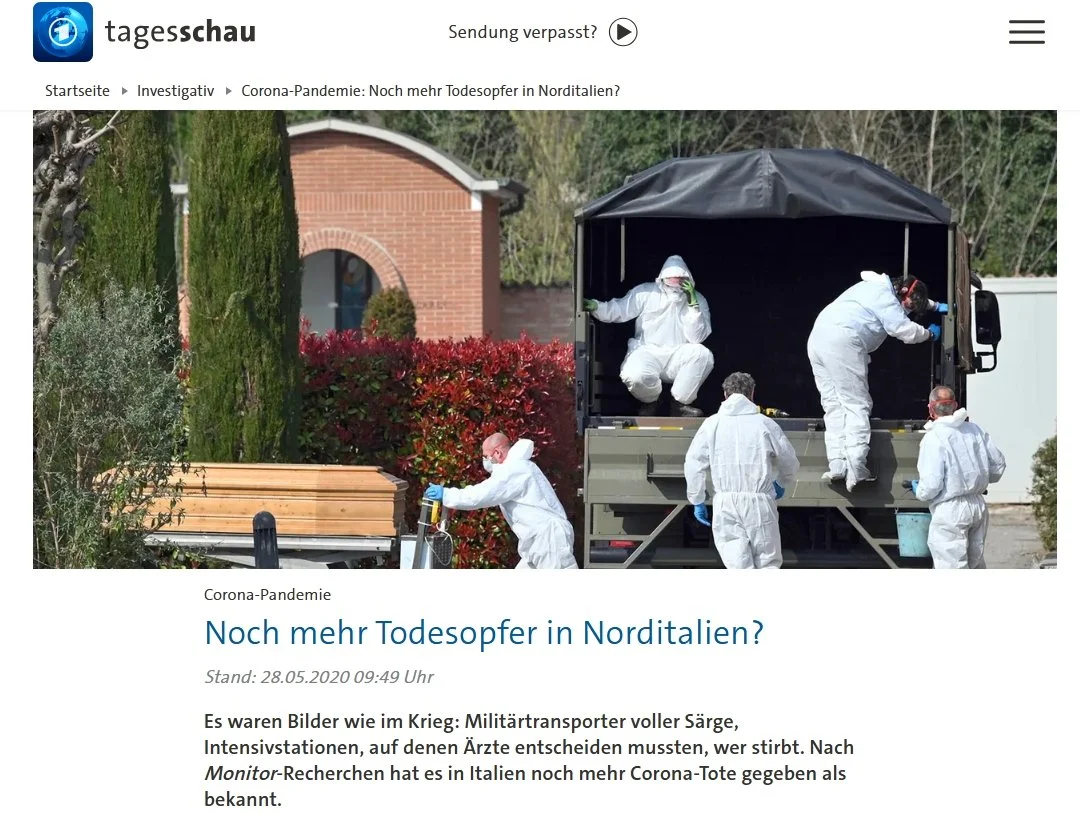
Screenshot: Tagesschau / WDR 28.05.2020
But shock images also have an antidote—namely, information and clarification. In the decades before Corona—beginning with the rise of mass media, illustrated magazines, photojournalism at the beginning of the last century—an obviously so dramatic event with possibly thousands of victims would have called the concentrated power of journalism to the Valli Bergamasche. This, however, did not happen.